
Process Lasso Changelog & Release Notes: Version History and Updates
Tracking software updates is essential to maintaining a responsive, stable Windows environment, and this comprehensive Process Lasso changelog provides a complete update tracker for power users and administrators. A detailed changelog offers full transparency into how the software evolves, detailing every bug fix, security patch, algorithmic refinement, and feature rollout Bitsum introduces. Reviewing release notes before updating helps you understand underlying system changes, evaluate potential compatibility adjustments, and decide whether a new build addresses specific performance bottlenecks on your machine. For users unfamiliar with the software foundation, our What Is Process Lasso guide explains the architecture and core technologies behind these updates. Unlike generic patch summaries, this page delivers user-focused explanations of ongoing improvements in Windows process management, background workload priority control, and real-time thread scheduling.
How to Rollback Process Lasso Version
If a recent update introduces an unexpected conflict or edge-case bug on your specific hardware configuration, rolling back to a previous stable build is straightforward:
| Version | Release Date | Status | Highlights |
|---|---|---|---|
| v18.3.0.34 | September 2026 | Stable | Expanded GPU telemetry metrics, refined ProBalance scheduling loops, and enhanced graph rendering performance. |
Current Stable Version Overview
The current stable release represents the pinnacle of reliability, having undergone rigorous validation across diverse Windows 10 and Windows 11 hardware configurations. Stable versions are strongly recommended for most users, including gamers, developers, and enterprise administrators who prioritize absolute system uptime over experimental features. Unlike test builds, stable releases are vetted to prevent unexpected edge-case conflicts with third-party anti-cheat software, kernel-level drivers, and background monitoring utilities.
Full compatibility is maintained across modern multi-core architectures, ensuring seamless execution on both traditional desktop processors and hybrid chips utilizing performance and efficiency cores.
Recent Changes and Improvements
Recent updates focus heavily on tightening background thread responsiveness while minimizing the software’s own resource footprint. Instead of obscure developer shorthand, the real-world impact for everyday operators includes significantly smoother multi-tasking under heavy workloads and more intuitive hardware telemetry visualization. Process enumeration handling has been fundamentally streamlined, meaning the utility detects and displays running applications faster and with greater reliability. Memory management routines, including SmartTrim triggers, have also been fine-tuned to release inactive working sets without inducing stutter during active foreground tasks.
Should Gamers Update Process Lasso?
For competitive and casual gamers, keeping Process Lasso updated is highly recommended, especially when playing titles that demand stable frame rates and minimal 1% lows. Version 18 introduced advanced multi-GPU tracking and enhanced ProBalance Algorithms that prevent background application spikes from stealing CPU cycles away from active game sessions. Updating ensures you avoid micro-stutters caused by background launchers, Discord overlays, or anti-cheat synchronization routines. Gamers can also optimize their systems further using recommended Process Lasso Best Settings for Gaming.
Should You Update Process Lasso Before Windows Update?
Major Windows cumulative updates and biannual feature upgrades frequently alter thread scheduling behaviors, DWM rendering pipelines, and kernel hooks. Updating Process Lasso immediately before or alongside a major Windows patch guarantees that you have the latest compatibility fixes. Bitsum regularly rolls out maintenance patches specifically tailored to align with Microsoft’s OS build modifications, preventing conflicts between the Process Lasso governor and Windows security baselines. Microsoft regularly documents Windows updates, system changes, and operating system compatibility considerations through its official Windows release health resources.
Latest Process Lasso Release
Staying informed about the newest software iteration ensures your system benefits from the latest performance breakthroughs and stability patches. The table below outlines the current release metrics for the software:
Where to Download Older Versions
Official previous versions and historical builds can be accessed directly through Bitsum’s legacy release channels or verified software archives such as Uptodown and Softonic. Always ensure you download legacy binaries from official or trusted mirrors accompanied by clean antivirus scan reports to prevent downloading compromised installer packages.
Process Lasso Version History
Examining the historical evolution of the software reveals a clear trajectory toward deeper hardware integration and finer-grained control over Windows NT thread scheduling. Major version milestones have transformed the utility from a basic priority regulator into an advanced automated governor capable of managing complex CPU affinities, core parking states, and GPU metrics
18.3.0.34 – September 2, 2026
Introduces the Process Startup Boost feature and adds a complete Turkish translation. The process context menu’s “Boost” command is renamed to “Thread Boost” for clarity, and the DELETE key now removes selected rows in all rule dialogs. It also fixes GPU Preference rules occasionally being lost, improves multi-GPU classification, adds component process states to diagnostics reports, and caps displayed CPU Utility values at 100 percent.
18.2.3.42 – July 31, 2026
Focuses on the Edit Rules window, where “Show All” and “Hide Empty” become layout-preserving toggles, column order is now persisted, and a new “Reset Columns” menu item plus a titles-only auto-resize variant appear. ThreadRacer gains a SIMD vector benchmark algorithm and precise runtime control, while a new option suppresses SmartTrim’s “no action” log entries. Config profile export and switching behavior is also improved.
18.2.2.10 – June 5, 2026
A maintenance release that fixes a phantom iGPU adapter appearing on some multi-GPU systems and corrects Foreground Boosting when the promoted priority class was set to “none.” Per-process GPU utilization collection receives assorted optimizations, and additional GPU enumeration data is added to diagnostics reports.
18.2.1.6 – May 29, 2026
Installer translation warnings are cleaned up, the Finnish translation is fixed, and the last 50 log entries are added to diagnostics reports.
18.2.0.50 – May 22, 2026
Adds a load-based power profile switcher that changes power plans according to system load. Multi-GPU support is extended with per-process readings in the Active Processes view, GPU numbers in the graph legend, and widgets that adopt the graph’s GPU line colors — plus user-customizable GPU widget colors. A new View option controls per-process GPU data collection, and a diagnostic data collection tool is added to the Help menu.
18.1.0.44 – May 5, 2026
Brings display support for multiple GPUs across the widget, line graph, status bar, tooltips, and process lists, with a toggle for consolidated versus per-GPU graph lines. It also introduces GPU Preference rules for steering processes to a chosen graphics adapter, and extends Regular Expression support to Instance Count Limit rules.
18.0.1.24 – April 15, 2026
Adds a context menu to the GPU widget for easy disabling, shows a hyphen in GPU columns when collection is off, and allows custom GPU utilization colors. CPU core graph rendering uses less GPU, ThreadRacer marks AMD-indicated fastest cores with an asterisk, and RegEx caching is adjusted for delayed process metadata attribution.
18.0.0.68 – April 3, 2026
A major release adding GPU utilization monitoring and a visual overhaul of the primary graph with anti-aliasing, a filled CPU area, and better fonts. ThreadRacer is rebuilt with a core heatmap, selectable algorithms and test durations, an end-of-run report, dark mode, and 3D V-Cache core marking. Regular Expression rule performance is boosted, and dark mode reaches CPUEater.
17.1.0.50 – March 3, 2026
Adds a “Recently terminated” tab to the process selection dialog and a configurable CPU utilization threshold for IdleSaver engagement. Dark mode is extended deeper into the product, and several dialogs receive cosmetic improvements.
17.0.2.20 – January 21, 2026
Adds an INI toggle that controls whether rules may be enforced on start_protected_game.exe.
17.0.2.18 – January 20, 2026
Allows rules to be enforced on start_protected_game.exe with a mandated 5-second delay for CPU affinity rules, and adds an Instance Balancer algorithm that spreads instances across NUMA nodes. The JSON rules schema gets a minor update, and graph tooltips are fixed when “Always on top” is enabled.
17.0.1.18 – January 1, 2026
Adds a menu to the Edit Rules window with config profile and file import/export actions, shows the active config profile there, and brings dark mode to the Named Config Profile dialogs. Copyrights roll over to 2026.
17.0.0.132 – December 10, 2025
Introduces the consolidated “Edit Rules” view where every rule type can be managed from a single dialog, reachable from a new main-window button, alongside a dedicated process-match-phrase input dialog and running-process and installed-game pickers in the rule creation flow. Dark mode reaches roughly 30 additional dialogs, foreground boosting now takes precedence over CPU and GPU priority rules, and the legacy IE restriction feature begins deprecation.
16.1.0.46 – November 6, 2025
Puts config profiles in the tray menu with a management submenu, enables importing and exporting all profiles as a zip archive, allows renaming the default profile, and raises the maximum number of named profiles. It also fixes Foreground Boosting not fully applying to a process that entered the foreground while under ProBalance restraint.
16.0.2.10 – September 3, 2025
A small fix release correcting an issue with importing Dynamic Thread Priority Boost OFF rules, plus translation updates.
16.0.1.16 – August 1, 2025
Adds user-defined exclusions to automatic game detection and ships substantial translation updates. It also adjusts the default integrity level of Watchdog launch actions and fixes Dynamic Thread Priority Boost rule ordering not being preserved when exiting the config dialog.
16.0.0.42 – July 10, 2025
Adds GPU priority class support throughout the product, including a GPU priority boost option in the improved Foreground Boost feature — which gains a dedicated config dialog and a choosable priority class. On Windows Servers, the GUI now auto-starts for the current user only by default.
15.1.1.26 – May 27, 2025
Refactors the Keep Running (auto-restart) feature, adding a per-rule option to launch elevated or not, and prompting to switch the Governor from service mode to a normal process when adding a rule while it is deployed as a service. The CPU affinity delay option is always shown instead of hiding behind “Show Advanced,” and DualSenseX is excluded from automatic game detection.
15.1.0.50 – February 20, 2025
Adds selective import and export of process rules to JSON via the File menu, plus copy and paste rule actions in the process list. The responsiveness graph turns teal on dark backgrounds, “Remove All Rules” now removes only exact matches, and the advanced-feature trial period is extended on Windows Servers.
15.0.4.22 – January 6, 2025
Fixes a rare startup issue for limited users that could needlessly launch net.exe, and changes automatic game detection for Performance Mode to default off so users consciously enable it. ProBalance exclusions for game launchers are adjusted accordingly, and a confirmation prompt is added to the restart-as-admin action.
15.0.3.22 – November 25, 2024
Fixes saving Watchdog launch actions whose command lines start with a hyphen, adds up and down ordering buttons to Config Profile Switcher rules, and supports the undocumented “lowest” memory priority through registry enforcement. The percent sign is dropped from the CPU and RAM graph titles as implied.
15.0.2.18 – October 17, 2024
Removes the hard trial period on Windows Servers so free features can be used indefinitely, and makes I/O priority rules a free feature. It also fixes Prevent Sleep rules on Windows 11 when only the display sleeps, and decouples the config profile display on the graph from ProBalance statistics.
15.0.1.16 – September 20, 2024
Adds column visibility selection dialogs to supplement the menu-based toggles, and excludes Steam’s vulkandriveryquery helper processes from automatic Performance Mode so it doesn’t flicker during Steam startup. Manual process restart handling is improved.
15.0.0.50 – September 3, 2024
Adds an “Enforce by Windows Registry” option to all priority rules, allowing priority enforcement on otherwise inaccessible processes such as anti-cheat-protected games, with a dedicated dialog to view and remove registry-backed priorities. New Elevated and Session ID process columns appear, a “Restart as Admin” context menu item is added, and IdleSaver now signals ParkControl through an event.
14.3.0.58 – August 19, 2024
A minor release fixing the CPU Sets rules config dialog’s select-button description and standardizing the appearance of the I/O Priority and Memory Priority dialogs.
14.3.0.54 – August 13, 2024
Refactors Dynamic Thread Priority Boost rules with a distinct context submenu and a new config dialog, and adds a System Reserved CPU Sets configuration tool. The Instance Balancer gains an option to randomize core distribution, and power modes are shown on all systems where they exist.
14.2.0.32 – July 1, 2024
Extends the CPU Affinity and CPU Sets dialogs with controls to select entire CCDs on AMD platforms and to demarcate frequency and cache CCDs on 3D V-Cache CPUs, plus whole-column checkbox selection. It suppresses recurring access-denied log entries when Forced Mode is used with broad rules, and fixes large CPU Limiter act-for durations.
14.1.1.16 – June 14, 2024
Renames the “Keep Awake” menu item to “Prevent Sleep” for consistency, fixes the month placeholder variable in sampling output filenames (now %MM%), and ensures rule ordering isn’t lost when saving in some dialogs.
14.1.0.20 – May 25, 2024
Pauses process list updates while the CTRL key is held, with a PauseOnControlKey registry setting to control it. New rules are inserted at the beginning of lists to preempt broad matches at the end, and the licensee name on the graph defaults to off for new installs.
14.0.3.16 – May 7, 2024
Consolidates the product editions by removing the distinct Server Edition — the workstation edition now installs on Windows Servers, making Process Lasso more affordable, or even free, to use on servers. Thread priority boost rules can also now be set through the multi-select process context menu.
14.0.2.12 – April 17, 2024
Allows workstation licenses to activate the server edition as the licensing distinction is removed, and adds start_protected_game.exe to the blacklist for rule enforcement.
14.0.1.10 – March 20, 2024
Fixes NUMA node control visibility on some systems, adjusts ProBalance defaults for certain systems, and improves the migration of users to the new default ProBalance settings.
14.0.0.40 – March 7, 2024
Introduces named CPU affinities, which can be created in the affinity selection dialog and then picked directly from context menus. ProBalance defaults are tuned for heterogeneous processors, and the processor group dropdown and NUMA checkboxes are now hidden, rather than disabled, when not applicable.
12.5.0.38 – February 12, 2024
Improves Power Modes support, describing a process in EcoQoS with a non-idle priority class as being in “Partial Efficiency Mode.” ThreadRacer marks E-cores with an ‘E’ appendage, and Performance Mode defaults to the Max Performance overlay on Power Mode systems where Bitsum Highest Performance isn’t installed.
12.4.7.20 – January 12, 2024
Adds common game platform launchers to the stock ProBalance exclusions and changes the Insights default sort to descending restraint count. The unenforceable “critical” I/O priority level is removed, and the Finnish and German translations receive large updates.
12.4.6.10 – January 5, 2024
Adds P-core and E-core counts to the CPU topology string in the About dialog and status bar, and includes Epic Games in automatic game detection. Eco leaf icon painting on core graphs is fixed for edge cases, and the filtered log view gains context menu support.
12.4.5.8 – December 28, 2023
Reverts the Automatic Game Detection default back to ON (only new installs or config resets were affected) and improves the confirmation flow when terminating or restarting critical system processes like Explorer.
12.4.4.22 – December 20, 2023
Allows wildcards in Performance Mode basename matches and adds IdleSaver exclusion list management to its config dialog, while automatic game detection for Performance Mode defaults to off for new installs. It also fixes a zombie-process edge case when enforcing Efficiency Mode on suspended processes.
12.4.3.14 – November 29, 2023
Adds a “Pause on Right-Click” option, on by default, that pauses the process list and graph while a context menu is open, with a paused icon shown on the graph.
12.4.2.44 – November 11, 2023
Adds Stagger, P-Cores, and E-Cores quick-select buttons to CPU Affinity selection, plus an option to apply the System Timer Resolution change globally. Regular Expression support extends to I/O priority, memory priority, and disallowed process rules, and SmartTrim’s Standby List and File Cache purge operations are decoupled.
12.4.1.10 – October 13, 2023
Fixes Efficiency Mode OFF rules incorrectly enforcing a normal priority class and overriding other priority rules — now the priority class resets only if it was previously idle. IdleSaver recovery information moves to the registry, and users can exit the beta channel while on a beta build.
12.4.0.44 – September 26, 2023
Distinguishes E-cores in the graphs with leaf icons, adds delayed CPU affinity rules for games that struggle at startup with custom affinities, and introduces a “Remove All Rules” process action. Bitsum Highest Performance is tuned to prefer P-cores when plugged in, ThreadRacer expands to 16 threads plus one with selectable affinity, and ProBalance’s “round robin affinity” becomes “drop one random core.”
12.3.2.20 – September 1, 2023
Ties the idle priority class to Efficiency Mode to match Task Manager’s behavior, and fixes cores incorrectly showing as parked on Intel 12th Gen and newer — a bug that also affected Task Manager and Resource Monitor. Efficiency Mode OFF rules are now continuously reapplied to catch threads put into Efficiency Mode individually.
12.3.1.20 – July 18, 2023
Adds a %sessionid% variable to Watchdog launch actions, removes the legacy MakeService executable from service management, and adds a “Locate / Properties” process context menu item. Instance Balancer non-RegEx wildcard matches are fixed to test against pathnames.
12.3.0.24 – June 7, 2023
Adds support for Windows 11’s Efficiency Mode, with dedicated rules, status column display, and a ProBalance option to use Efficiency Mode during restraints. Persisting a custom System Timer Resolution becomes a Pro feature, and Efficiency Mode ON/OFF rules get their own ‘E’/‘e’ symbols.
12.2.0.16 – May 23, 2023
Adds a tool to set and persist the System Timer Resolution up to 0.5ms, and refines IdleSaver’s config dialog behavior when enabling it for the first time from the tray menu.
12.1.0.26 – April 3, 2023
Adds copy-to-clipboard actions to the process context menu, blocks automated updates while a device is in fullscreen mode, and makes CPU Sets free in beta builds. The process context menu is reorganized with a new Copy submenu.
12.0.4.4 – February 22, 2023
Fixes a crash when processes run from remote paths (in shell32.ExtractAssociatedIcon) and renews the code signing certificate.
12.0.3.16 – February 3, 2023
Lets the Keep Awake Indefinite setting persist across reboots, with a registry option to opt out, and allows exiting the beta channel while using a beta version once a release build arrives.
12.0.2.18 – January 3, 2023
Adds an /activateonly command line parameter to perform deferred license activation from the installer, suppresses Governor INI parsing error message boxes when running as a service, and shows a precise error when a Workstation key is used on the Server Edition.
12.0.1.6 – November 23, 2022
Fixes graph tooltips being vertically clipped at some font scalings and the tray icon not reflecting CPU Utility values over 100%, and adds the product version to the user-agent string.
12.0.0.24 – November 15, 2022
Adds support for Windows Balanced Power Modes (overlays) and switches the default CPU metric to CPU Utility % instead of CPU Time % across the graph, tray, and core graphs. It also supports the 3995WX topology where a NUMA node spans more than 64 logical cores across multiple processor groups.
11.1.1.26 – October 10, 2022
Refactors priority class rules to support Regular Expressions and adapts ProBalance’s “Disable CPU Core Parking during action” option to Intel 12th Gen, moving failsafe core parking recovery options from HKCU to HKLM. Dark mode reaches more dialogs, and Spanish becomes selectable in the installer.
11.1.0.34 – September 6, 2022
Expands the Instance Balancer with a “Disable SMT” rule option and a “Show Advanced” button, adds the Korean language, and supports tree view mode when process icons are disabled. SmartTrim now excludes the Memory Compression process, and internet search URLs switch to HTTPS.
11.0.0.34 – August 15, 2022
Introduces a processes tree view as a third sort option on the name column, alongside a new parent process PID and basename column. Graph tooltips become more useful, showing the most active process, CPU utilization, and ProBalance events at any hovered point, and the Disallowed Processes dialog is enlarged and improved.
10.4.8.8 – June 8, 2022
Improves service management code, fixes service tracking for process associations going stale, and updates the build to Visual Studio 2022 17.2.3.
10.4.7.22 – May 9, 2022
Offers to repair dysfunctional system performance counters (via lodctr /R), adds an Experimental submenu with a Generate Crash Dump option, and lays groundwork for a minidump upload tool. Base process enumeration and tracking code is improved.
10.4.6.20 – April 15, 2022
Adds support for processor groups of unequal sizes and extends the Instance Balancer to balance across all processor groups, with improved reserved-cores behavior when instances outnumber cores. It also fixes the “start with” power profile overriding Performance Mode’s manual power switch.
10.4.5.28 – March 24, 2022
Converts the Instance Balancer’s “only include instances with CPU use” boolean into a floating-point CPU use threshold, fixes a SmartTrim memory leak and a handle leak, and fixes Group Extender consuming excess compute with multiple simultaneous extensions.
10.4.4.20 – February 18, 2022
Switches to a 2022 EV code signing certificate and makes Foreground Boosting a free feature. A /trimnow command line switch triggers an immediate SmartTrim action, and post-trial free installs can now open Pro-only rule dialogs (with the Add button restricted).
10.4.3.24 – January 28, 2022
Makes Bitsum Highest Performance core parking compatible with Alder Lake on Windows 10, including a one-time adjustment that unparks all P-cores on existing installs. The memory priority feature is refined to show values as names throughout, and the build retargets to Visual Studio 2022.
10.4.2.16 – January 5, 2022
Adds a CTRL+SPACE accelerator to pause GUI display updates, and makes “Start Process Lasso with power profile” act as a base profile that applies when no power rules are active. A new ProBalance option lowers restrained processes to Idle instead of Below Normal, and a View/Reset submenu is added.
Process Lasso Release Notes
Detailed release notes break down technical modifications version by version, ensuring transparency for advanced administrators who manage multiple Windows endpoints.
New Features and Enhancements
Newly introduced functionalities focus on automated system governance and proactive responsiveness protection. Recent tools include smarter watchdog triggers that react instantly to runaway background processes, as well as enhanced GUI controls for manual thread manipulation. These enhancements translate directly to a more fluid desktop experience, preventing runaway background tasks from starving foreground applications of critical CPU cycles.
Advanced users can further customize these behaviors through process lasso configuration options and system-level settings.
Bug Fixes and Performance Improvements
Stability fixes and crash prevention updates form the backbone of every minor software revision. Resolving handling adjustments have successfully resolved rare memory leaks associated with prolonged logging sessions, while compatibility patches ensure smooth operation alongside major Windows cumulative updates. These refinements guarantee that continuous background monitoring remains lightweight and entirely unnoticeable during day-to-day computing.
Compatibility and System Updates
Bitsum maintains rigorous compatibility standards across supported Windows versions, including deep integration with Windows 11 scheduling quirks. Hardware support updates ensure optimal interaction with modern asymmetric core layouts, preventing scheduling conflicts on modern silicon. Driver components and system hooks are routinely updated to comply with strict kernel security requirements without sacrificing optimization efficacy.
Process Lasso Beta Builds and Experimental Releases
For enthusiasts who want early access to cutting-edge features before they hit the stable branch, experimental builds offer a glimpse into the future of Windows optimization.
What Are Process Lasso Beta Builds?
Beta versions contain upcoming changes, experimental algorithms, and newly developed interface elements still undergoing active testing. They allow power users to test upcoming features early and provide feedback to developers. However, because these builds may include unfinished improvements or undiscovered edge-case bugs, they are strictly recommended for advanced users, testing environments, and enthusiasts who enjoy living on the bleeding edge rather than mission-critical production workstations.
Stable Release vs Beta Version
| Feature | Stable Version | Beta Version |
|---|---|---|
| Reliability | Higher, thoroughly vetted for daily use | Active testing phase, potential minor bugs |
| New Features | Released after extensive validation | Available early for testing |
| Recommended Users | Everyday users, gamers, and professionals | Advanced users, testers, and enthusiasts |
What’s New in Process Lasso v18?
Version 18 represents a watershed moment for the software, packing massive architectural updates tailored for modern multi-core hardware and complex multi-GPU setups.
Major Features Introduced in v18
The headline addition in v18 is comprehensive multi-GPU support, allowing users to track GPU loads alongside traditional CPU metrics. Improved monitoring graphs and streamlined rule imports make managing complex automation profiles faster than ever before.
Users can learn how these saved preferences work by exploring Process Lasso Rules and their persistent behavior across system restarts.
Improvements to Performance and User Experience
Under the hood, v18 features cleaner execution loops that reduce idle overhead and speeds up interface rendering. Usability refinements streamline the process of creating persistent rules, ensuring that custom configurations apply instantly across system reboots.
Process Lasso Update Timeline
| Version | Date | Major Update |
|---|---|---|
| v18.x | Recent | Multi-GPU support, refreshed graph aesthetics, and expanded telemetry. |
| v17.x | Historical | Consolidated rules view and improved hybrid core handling. |
Major Version Milestones
Milestone releases have consistently pushed the boundaries of what automated software can achieve on Windows. From the introduction of the proprietary ProBalance algorithm to modern GPU metrics and core parking overrides, each major version has redefined software-based responsiveness.
Important Maintenance Updates
Minor maintenance patches play a critical role in day-to-day reliability, delivering targeted security improvements, minor bug fixes, and swift compatibility adjustments whenever Microsoft rolls out major operating system patches.
How to Check Your Process Lasso Version
Verifying your currently installed build number takes only a few seconds through the graphical interface:
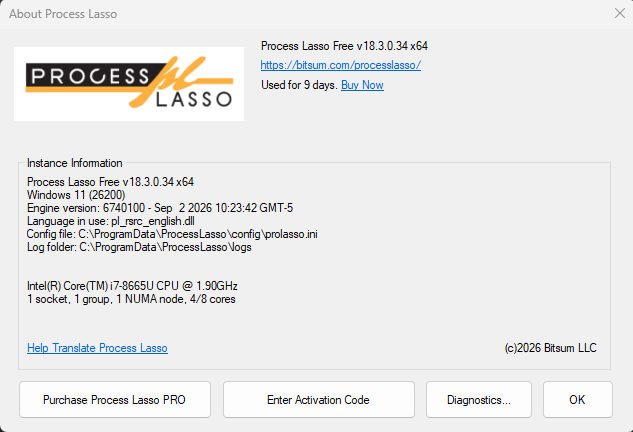
Figure: Process Lasso About dialog box displaying the exact version number, build, and system architecture.
Should You Update Process Lasso?
Deciding whether to update depends heavily on your current system stability and your desire for new features. You should update immediately if your current version exhibits known bugs, if you require compatibility fixes for a recent Windows update, or if you want access to newly introduced optimization algorithms. Conversely, if your system is operating with flawless stability and you lack the time to test new configurations, staying on your current stable version is a valid approach.
Frequently Asked Questions
Final Verdict: Should You Keep Process Lasso Updated?
Keeping Process Lasso updated ensures your system maintains access to the latest performance improvements, security enhancements, and compatibility patches. For everyday users and gamers, sticking with the latest stable release guarantees maximum reliability. Advanced users and testers can leverage beta builds to explore upcoming features early, while anyone troubleshooting system quirks should review recent patch notes to see if a known issue has already been resolved.If problems continue after an update, follow the Process Lasso troubleshooting guide for common fixes and configuration solutions.
